
ADVERTISEMENT
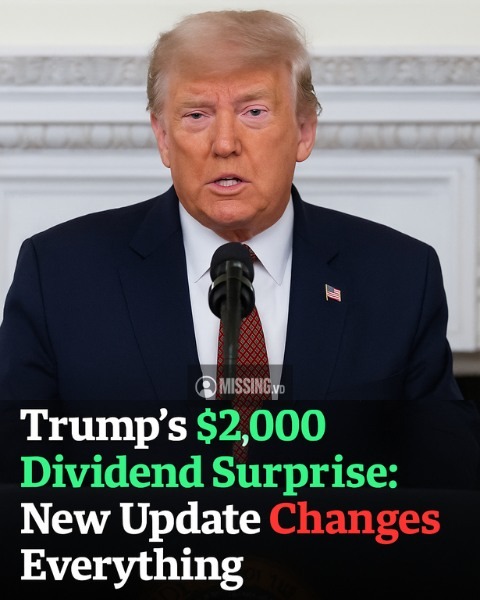
Donald Trump has tied his sweeping tariff agenda to an eye-catching promise: a $2,000 “dividend” for every American who isn’t considered high-income. No timeline, no details, no qualifying rules — just a bold declaration. It’s not the first time he’s floated it. Last summer he teased a tariff-funded rebate, repeated the idea again in October, and now, with tariff revenue climbing and legal challenges heating up, he’s doubling down.
To hear him tell it, tariffs are the engine that will pay for everything. He frames them as the cleanest solution to America’s economic problems — a revenue stream, a manufacturing booster, and now, a direct cash pipeline to households. On Truth Social, he launched into one of his familiar bursts, insisting critics “are FOOLS,” claiming the United States is now “the Richest, Most Respected Country In the World,” and pointing to “Almost No Inflation” alongside record stock market growth. He insisted that tariff revenue is so strong that the country will “soon begin paying down our ENORMOUS DEBT.” In his telling, factories are rising everywhere, investments are pouring in, and tariffs are the reason behind it all.
But his most aggressive push comes from the argument that presidential power over trade is absolute. If he can halt all trade with a foreign nation — which he claims presidents are fully allowed to do — why shouldn’t he be able to impose broad tariffs for national security reasons? He blasted the Supreme Court with a rhetorical barrage, questioning whether the justices even understood how tariffs supposedly fuel economic expansion. To him, the idea that other nations can tariff the U.S. while the U.S. is supposedly constrained is outrageous. And he insists businesses are relocating to America “ONLY BECAUSE OF TARIFFS.”
It’s a clean pitch politically. Tariffs generate revenue. Revenue funds the $2,000 payout. Americans feel the benefit immediately. But the math — and the law — tell a much more complicated story.
Analysts digging into the numbers have flagged two giant obstacles: cost and legality. Even under the rosiest revenue scenarios, the payout is massively expensive. Economist Erica York estimates that if eligibility cuts off at $100,000 in annual income, roughly 150 million adults would qualify, pushing the total cost toward $300 billion. And that’s the low-end estimate. Arnold Ventures’ co-chair put the number closer to $513 billion, depending on how the program defines “high income,” and whether children qualify for the payment.
Meanwhile, tariff revenue doesn’t come close. Adjusted for Trump’s proposed structure, tariffs have brought in about $90 billion in net revenue — a fraction of what the rebate would require. Even the $195 billion collected through customs duties in the first three quarters of 2025 falls far short. And that’s assuming the current tariff system remains intact.
Legally, that’s a major assumption.
Trump’s tariff approach leans heavily on the International Emergency Economic Powers Act (IEEPA) — the law typically used for targeted sanctions, not blanket import taxes. Three federal courts have already ruled that the administration’s use of IEEPA to justify broad tariffs is unlawful. Now the Supreme Court has taken up the issue. If the justices strike down this interpretation, Trump’s entire tariff structure could collapse overnight, taking the imagined payout with it.
That’s the real Achilles’ heel: the plan depends on revenue that may not legally exist for much longer.
Even setting legality aside, basic practical questions remain unanswered. Trump hasn’t said what qualifies as “high income,” or whether the program would mirror something like pandemic stimulus thresholds. He hasn’t clarified if children or dependents would receive payments. There’s no stated timeline and no funding mechanism beyond “tariffs will pay for it.” Economists warn that even if tariff revenue doubled, the payout still wouldn’t pay for itself — not without massive new taxes or deficits. And, of course, tariffs function like hidden taxes on consumers, raising the cost of imported goods and often leading to retaliatory measures abroad.
Still, the political logic is unmistakable. A $2,000 check — promised directly from tariff revenue — allows Trump to sell tariffs as something more than an abstract trade tool. It reframes them as a personal benefit, a direct deposit straight into voters’ pockets. Supporters get a simple message: tariffs equal cash, strength, and national prosperity.
The reality is much murkier.
The administration’s pitch leans on the idea that tariffs fuel domestic growth. But economists widely dispute this, pointing out that tariffs generally increase consumer prices and disrupt supply chains. The promise of a rebate doesn’t erase those costs — it just masks them. Even York’s conservative revenue estimate assumes tariffs remain untouched by courts, retaliation, or economic fallout, which is far from guaranteed.
And then there’s the broader context. Trump’s argument arrives during a period of heightened legal scrutiny, escalating court battles, and questions about presidential authority. As he pushes a narrative of America as “the richest, most respected country,” the judiciary is wrestling with whether his tariff policy even fits within the law. His insistence that tariffs alone will pay down trillions in national debt ignores basic fiscal reality. And his attacks on critics — painting them as uninformed or unpatriotic — don’t address the underlying numbers.
The $2,000 payout serves as a headline-grabber, a simple round figure that voters understand immediately. But it raises more questions than answers. Who gets it? When? How will it be funded? What happens if the courts dismantle the tariff system? And if tariff revenue falls short — as every economist expects — what gets cut to make up the gap?
Without clarity, the promise looks less like a policy and more like a political lever.
The bottom line is straightforward: don’t expect a $2,000 deposit hitting your bank account anytime soon. The legal foundation is shaky, the revenue is insufficient, and the details simply don’t exist. In the meantime, the debate will continue — part economic theory, part political theater, and part test of how far presidential power can stretch in the name of national security, trade, and campaign messaging.
Despite the noise surrounding the promise, the actual path to delivering it remains full of roadblocks, uncertainties, and looming court decisions that could undermine the entire idea before it ever leaves the runway.
ADVERTISEMENT
