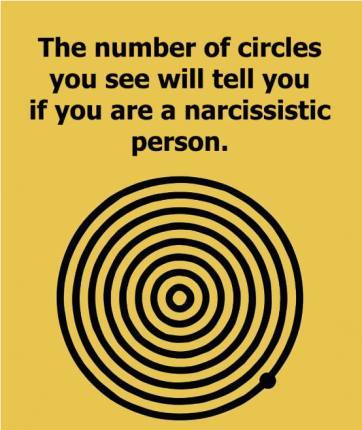
Are You a Narcissist? The Number of Circles You See Could Reveal It
You’ve probably seen it while scrolling late at night.
“The number of circles you see reveals whether you’re a narcissist.”
Thousands of comments flood in.
“I see 7—what does that mean?”
“I only see 3… should I be worried?”
“My friend sees 15 and now we’re arguing.”
But can a simple optical illusion really reveal something as complex as narcissism?
Short answer: not exactly.
Long answer: the illusion is fascinating, narcissism is misunderstood, and our obsession with these tests says a lot about human psychology.
Let’s break it all down.
Why We’re Obsessed With Personality Tests
From astrology to Myers‑Briggs, from BuzzFeed quizzes to TikTok psychology hacks, humans love shortcuts to self‑understanding.
Because identity is complicated—and we’re wired to simplify it.
Personality tests promise:
Quick insight
Emotional validation
A sense of control
Social connection (“What did you get?”)
Optical illusions take this fascination one step further. They feel scientific. After all, your eyes aren’t lying… right?
What Is Narcissism, Really?
Before we talk about circles, we need to talk about narcissism itself, because the internet tends to flatten it into something it’s not.
Narcissism ≠ Self‑Love
Despite popular belief, narcissism is not just confidence, vanity, or enjoying selfies.
In psychology, narcissism exists on a spectrum.
At one end:
Healthy self‑esteem
Confidence
Self‑assurance
At the other extreme:
Narcissistic Personality Disorder (NPD), a clinically recognized condition
Most people fall somewhere in the middle.
Traits Commonly Associated With Narcissism
Narcissistic traits can include:
Strong need for admiration
Sensitivity to criticism
Desire to feel special or superior
Difficulty empathizing with others
Preoccupation with status, success, or appearance
Importantly, having one or two of these traits does not make someone a narcissist.
Context, frequency, and impact on relationships matter far more than any single behavior—or optical illusion.
The Viral “Circle Illusion” Explained
Now let’s talk about the image itself.
You’ve likely seen a black‑and‑white picture filled with overlapping circles. The instruction is simple:
“How many circles do you see?”
Different versions claim:
3–5 circles = empathetic, grounded
6–9 circles = balanced personality
10+ circles = narcissistic tendencies
Sounds convincing… but here’s the catch.
The Image Is Ambiguous on Purpose
The illusion is designed so that:
Some people see only large, obvious circles
Others notice smaller circles within circles
Some mentally “complete” partial shapes
This has less to do with narcissism and more to do with:
Visual processing style
Attention to detail
Pattern recognition
Cognitive interpretation
In other words: your brain is doing what brains do best—making sense of incomplete information.
What Optical Illusions Actually Measure
Optical illusions have been studied extensively in psychology and neuroscience—but not as personality tests.
They’re typically used to examine:
How the brain interprets visual data
Differences between global vs. local perception
Attention focus
Visual assumptions
For example:
Some people naturally focus on the “big picture”
Others immediately notice finer details
Neither style is better—and neither indicates narcissism.
So Why Do These Tests Feel So Accurate?
If the illusion isn’t scientific, why do people swear by it?
1. The Barnum Effect
The Barnum Effect is a psychological phenomenon where people believe vague, general statements are highly accurate for them personally.
Statements like:
“You care deeply but don’t always show it”
“You’re confident, but sensitive underneath”
“You sometimes struggle with self‑doubt”
Almost everyone relates to these.
So when the test says:
“Seeing many circles means you’re confident and self‑focused”
People think: Wow… that’s me.
2. Confirmation Bias
Once you read the description, your brain starts scanning for evidence that it’s true.
If you:
Enjoy attention → “Yep, narcissist”
Post selfies → “That checks out”
Feel misunderstood → “They nailed it”
You’re not discovering something new—you’re reinforcing what you already believe.
3. Social Identity and Labels
Labels are powerful.
Calling yourself:
“An empath”
“A narcissist”
“An overthinker”
“A people‑pleaser”
…can feel like clarity—even when it oversimplifies reality.
These tests give us a story about ourselves, and humans love stories.
The Problem With Calling Everyone a Narcissist
The word “narcissist” has become one of the most overused terms on the internet.
Someone disagrees with you? Narcissist.
An ex sets boundaries? Narcissist.
A boss is demanding? Narcissist.
This is dangerous for two reasons.
1. It Trivializes Real Mental Health Conditions
Narcissistic Personality Disorder is a serious condition that requires professional diagnosis.
Reducing it to:
A viral image
A circle count
A TikTok trend
…undermines real psychological understanding.
2. It Encourages Black‑and‑White Thinking
People are complex.
You can:
Want recognition and care deeply about others
Be confident and insecure
Enjoy attention and feel empathy
Personality is not a binary switch—and certainly not hidden in a picture of circles.
What Seeing More Circles Might Say About You
While it doesn’t reveal narcissism, your response to the illusion can still be interesting.
If you saw fewer circles, you might:
Focus on the overall image
Prefer simplicity
Process visuals holistically
If you saw many circles, you might:
Pay attention to details
Enjoy problem‑solving
Be visually analytical
These are cognitive styles, not moral traits.
They don’t make you better, worse, kinder, or more self‑absorbed.
Why We Secretly Want to Be “Diagnosed” by the Internet
There’s something comforting about being told who we are.
Real self‑reflection is hard.
It’s messy.
It requires honesty.
A viral test offers:
Instant answers
Zero vulnerability
No effort
But real personal growth doesn’t come from illusions—it comes from curiosity.
Continue reading…
