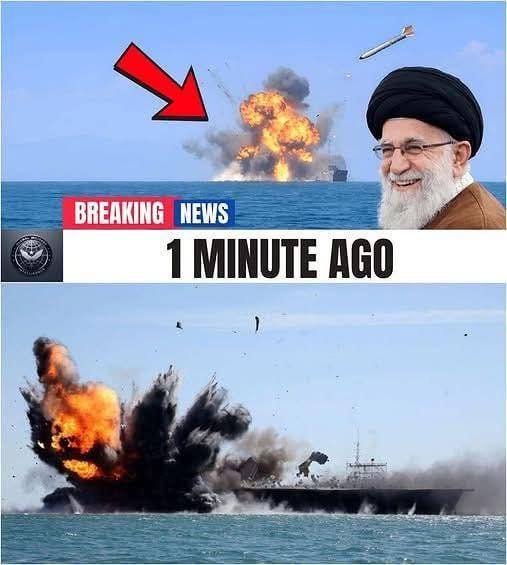
The symbolism of an aircraft carrier — often seen as the ultimate expression of U.S. military power — makes such drills rhetorically powerful, even if they do not reflect realistic combat outcomes.
2. Misinformation Ecosystem
Dramatic claims — especially ones involving iconic warships and short timeframes like “32 minutes later…” — are ideal for social media circulation. They:
-
are easily shared without verification,
-
and often conflate simulation, exercise, or mock representation with real events.
Unverified YouTube videos or social posts may depict hypothetical scenarios (sometimes labelled fictionally) that are then retold as if factual.
3. Real Regional Tensions
There are genuine sources of friction involving:
-
U.S. naval presence in the Persian Gulf and Arabian Sea,
-
Iranian threats to close the Strait of Hormuz,
-
Houthi militia attacks (Iran‑aligned) on ships in the Red Sea that have drawn U.S. responses.
None of these are the same as Iran successfully attacking a U.S. carrier.
Historical Incidents Versus Modern Claims
1987–1988: Tanker War and Operation Praying Mantis
In the late 1980s, during the Iran‑Iraq War and what was called the “Tanker War”:
-
The U.S. Navy engaged Iranian forces after mines laid by Iran damaged the USS Samuel B. Roberts.
-
In Operation Praying Mantis (April 1988), U.S. forces struck and sank Iranian naval vessels in retaliation.
-
These engagements occurred decades ago and involved smaller ships rather than aircraft carriers.
This history is sometimes referenced in military analysis when discussing potential U.S.–Iran naval clashes, but it does not validate claims of recent carrier sinkings.
Recent Red Sea and Gulf Incidents
In recent years:
-
Iran‑aligned Houthi forces in Yemen have fired missiles and drones at U.S. warships in the Red Sea.
-
Reports surfaced of U.S. carriers being targeted in these theater tensions, but not sunk.
Expert Analysis: “Can Iran Sink a U.S. Carrier?”
Defence commentators agree that sinking a U.S. carrier is technically possible in very specific and unlikely scenarios, but:
-
Modern carriers are defended by multiple layers of surface and air defenses,
-
They seldom operate alone, and
-
Targeting them at long range with precision requires very capable sensors that Iran does not publicly possess.
From a technical perspective, as summarized in recent analyses:
“Iran has missiles fast enough to threaten U.S. warships, but not the sensors needed to find them. Against a mobile aircraft carrier protected by layered defenses, hypersonic speed alone is not enough to guarantee a decisive strike.”
Why Carriers Matter Strategically
Understanding why these narratives resonate requires exploring the strategic significance of aircraft carriers:
Power Projection
U.S. carriers represent the ability to:
-
launch air operations globally,
-
support ground forces far from U.S. soil,
-
reassure allies through visible presence.
Their presence in the Persian Gulf and Indian Ocean is a signal of U.S. commitment to regional security.
Deterrence
The mere fact that carriers operate in contested waters is meant to deter aggression:
-
No adversary can assume the U.S. will not respond if attacked.
-
Threats or drills — even dramatic ones — do not equate to actual clashes.
The Danger of Misinterpretation
Claims that Iran took down a U.S. carrier can easily mislead:
-
Casual readers may confuse drills or simulations with real combat engagements.
-
Exaggerated narratives can escalate tensions psychologically even without physical conflict.
-
Policymakers and analysts rely on verified intelligence, not social media rumors.
When interpreting such claims, it’s essential to ask:
-
What are the primary sources? Are they official military reports or speculative videos?
-
Is the event corroborated by multiple credible outlets?
-
Is the context operational (real combat) or symbolic (exercise or simulation)?
In this case, credible reporting does not support the claim that Iran attacked and sank a U.S. aircraft carrier.
Conclusion: Separating Reality from Rumor
The bottom line is clear:
-
There is no verified incident in which Iran attempted to sink a U.S. aircraft carrier and then experienced a notable event “32 minutes later.”
-
Iran has staged mock attacks on full‑scale replicas of carriers during exercises, primarily for propaganda or training.
-
Tensions between Iran and the U.S. are real and ongoing, but so far have not escalated to direct carrier combat.
-
Analysis suggests Iran’s capabilities fall short of reliably sinking a carrier in modern naval warfare without significant external support.
Ultimately, dramatic headlines should be met with careful scrutiny, especially when they involve complex military dynamics and strategic communication campaigns on all sides.
