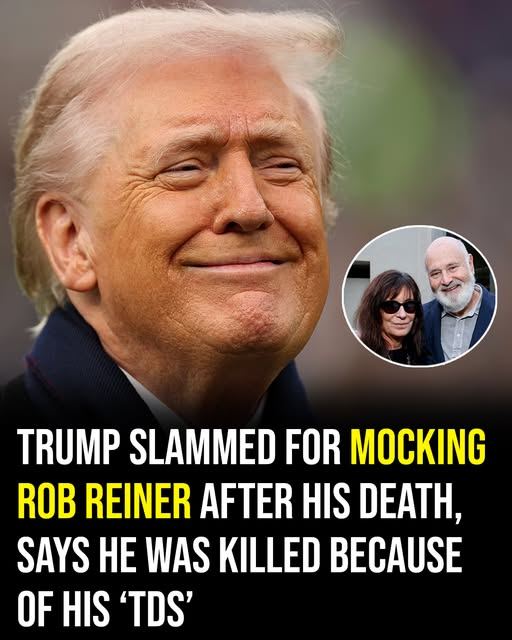
1. Background: Tragic Death of Rob and Michele Reiner
On December 14, 2025, legendary Hollywood filmmaker and actor Rob Reiner (director of The Princess Bride, When Harry Met Sally, A Few Good Men and others) and his wife, Michele Singer Reiner, were found dead in their Los Angeles home in Brentwood. Law enforcement treated it as an apparent double homicide and later arrested their son, Nick Reiner (32), on suspicion of murder and held him without bail.
The loss shocked Hollywood, political circles, and fans worldwide, generating tributes that reflected on both the Reiners’ artistic achievements and their personal legacy as advocates for various civic causes.
2. Trump’s Controversial Response
Rather than issuing condolences or focusing on the tragedy as a personal loss, President Donald Trump responded publicly in a way that quickly ignited fierce controversy.
Key details of Trump’s comments:
In a post on Truth Social the day after news of the deaths broke, Trump described the event not as a human loss but as an outcome tied to what he called “Trump Derangement Syndrome (TDS).”
He wrote that Reiner and his wife “reportedly died due to the anger he caused others through his massive, unyielding, and incurable affliction with a mind-crippling disease known as ‘Trump Derangement Syndrome.’”
Trump also labeled Reiner as “a tortured and struggling, but once very talented movie director and comedy star,” and emphasized his own political achievements in the same statement.
Later, when pressed by reporters in the Oval Office, Trump doubled down, calling Reiner “deranged” and saying he was “very bad for our country.”
3. Immediate Public Reaction and Backlash
Almost immediately, Trump’s comments sparked widespread backlash across the political spectrum, with criticism flowing from Democrats, Republicans, celebrities, commentators, and citizens alike.
3.1 Bipartisan Political Condemnation
Many lawmakers condemned the remarks, arguing that they injected politics into a personal tragedy and showed a lack of basic human empathy.
Republican Rep. Thomas Massie called the discourse “inappropriate and disrespectful” toward a man who had been murdered and suggested that Trump’s colleagues were ignoring the issue.
Republican Rep. Marjorie Taylor Greene framed the deaths as a family tragedy, not a political battleground, saying that Trump’s comments miscast the situation.
3.2 Criticism from Trump Allies
Jenna Ellis, a former Trump attorney, wrote that political commentary was entirely inappropriate following a murder and urged empathy.
Turning Point USA contributor Riley Gaines called Trump’s remarks “terrible taste” and said they lacked decency.
Perhaps most strikingly, ultra-conservative figure Nick Fuentes — who rarely criticizes Trump — labeled the president’s remarks “despicable” and “evil,” emphasizing that regardless of politics, a murdered couple deserved respect.
3.3 Celebrity and Cultural Response
Figures in entertainment and media likewise condemned the president’s comments:
Patrick Schwarzenegger called Trump’s remarks “disgusting and vile.”
His mother, Maria Shriver, referred to the comments as lacking basic human decency.
Comedian Seth Meyers on Late Night minced no words, saying Trump’s reaction cast a shadow over a tragic event and showed a president “incapable” of showing basic humanity.
Celebrities echoed similar thoughts, often emphasizing that political differences should not overshadow respect for a life and legacy.
4. Reactions on Social Media and Grassroots Commentary
Beyond mainstream media and political figures, Trump’s comments ignited fierce debate on social platforms:
Many conservative and MAGA-aligned users openly expressed discomfort or outright disgust at Trump’s stance, some saying it went “too far even by their standards.”
On Reddit and Twitter, reactions ranged from shock at the coldness of Trump’s messaging to broader discussions about the tone of political rhetoric in America.
Users highlighted how the remarks contrasted sharply with the conservative community’s condemnation of celebratory statements over the death of conservative activist Charlie Kirk earlier in the year.
Overall, what was meant to be a political jab turned into a flashpoint for broader criticism of political discourse norms and empathy in public life.
5. Context: TDS and Political Polarization
To understand the intensity of the controversy, it helps to unpack the term “Trump Derangement Syndrome (TDS).”
5.1 What Is “TDS”?
“TDS” is a pejorative phrase popularized among Trump supporters to describe opposition to Donald Trump, suggesting that critics are irrationally consumed by their dislike of him. It has been widely used in political commentary but is not a clinical term and is typically used to dismiss criticism rather than engage with it substantively.
In this case, Trump’s use of the term went farther — implying that Reiner’s personal demise was a direct personal consequence of his political opposition to Trump. This suggestion had no factual basis, especially as law enforcement investigations pointed to a family member as the chief suspect.
5.2 Political Fragmentation in the U.S.
The incident occurred in a political environment already marked by intense polarization:
The U.S. electorate is deeply divided along ideological lines.
Public figures have increasingly been targeted — verbally and sometimes physically — for their political views.
The assassination of activist Charlie Kirk earlier in 2025, and the controversies that followed, had already raised questions about how political violence and commentary interact in public life.
Trump’s comments fed directly into that environment, raising debates about whether political rhetoric escalates division and can potentially normalize extreme responses.
6. Trump’s Continued Defense
Despite mounting backlash, Trump did not retract his comments.
In statements to reporters and subsequent public messaging, he stood by the characterization of Reiner’s death being linked to “TDS” and reiterated his condemnation of Reiner’s political stances.
This refusal to soften or clarify his remarks reinforced criticisms that the president was more interested in political point-scoring than mourning a tragedy affecting a family and community.
7. Broader Reactions and Analysis
7.1 Editorial and Opinion Responses
Commentators on both sides condemned the approach:
Analysts described the comments as cruel or unparalleled in modern presidential discourse.
Some framed them as symptomatic of a broader erosion of norms in American politics, where personal attacks replace empathy, even in tragic circumstances.
While some conservative voices defended Trump’s right to comment politically, the widespread rebukes from across the political spectrum underscored how unusual and provocative the statements were.
8. Implications for U.S. Politics and Civil Discourse
The episode has stirred important debates:
8.1 Expectations of Public Office and Empathy
Traditionally, U.S. presidents — even deeply polarizing ones — have maintained a level of decorum when addressing the death or suffering of others, especially in violent or tragic circumstances. Trump’s approach challenged those unspoken norms and raised questions about presidential conduct.
8.2 Weaponizing Tragedy for Political Narrative
Critics argue that by tying a violent crime to political opposition, Trump blurred lines between personal tragedy and political narrative, potentially deepening partisan divides.
Continue reading…
